Dear, I open for direct swap. You can contact me via email : chiphoi001@yahoo.com. I collect: - Lunar new year; - Lady slipper & Dancing lady orchid; - Tom of Finland; - Inge Look Aunties; - Blue Cats World Trip; - Erotic (about men); - Van Gogh card from museum

presentation

My postcard album for swap
If you find something interesting in my album and want to swap, you can drop me some lines with your album. Thank you.
Affichage des articles dont le libellé est India. Afficher tous les articles

jeudi 14 juin 2018

India, Mail with an abundance of Bhoutan nice stamps,


Today is the first day of month of the Snake according to lunar calender. And they believe that the feeling, the stuff in that day will affect the rest days of month. For example, if you get hapiness, you will have a month full of happiness.

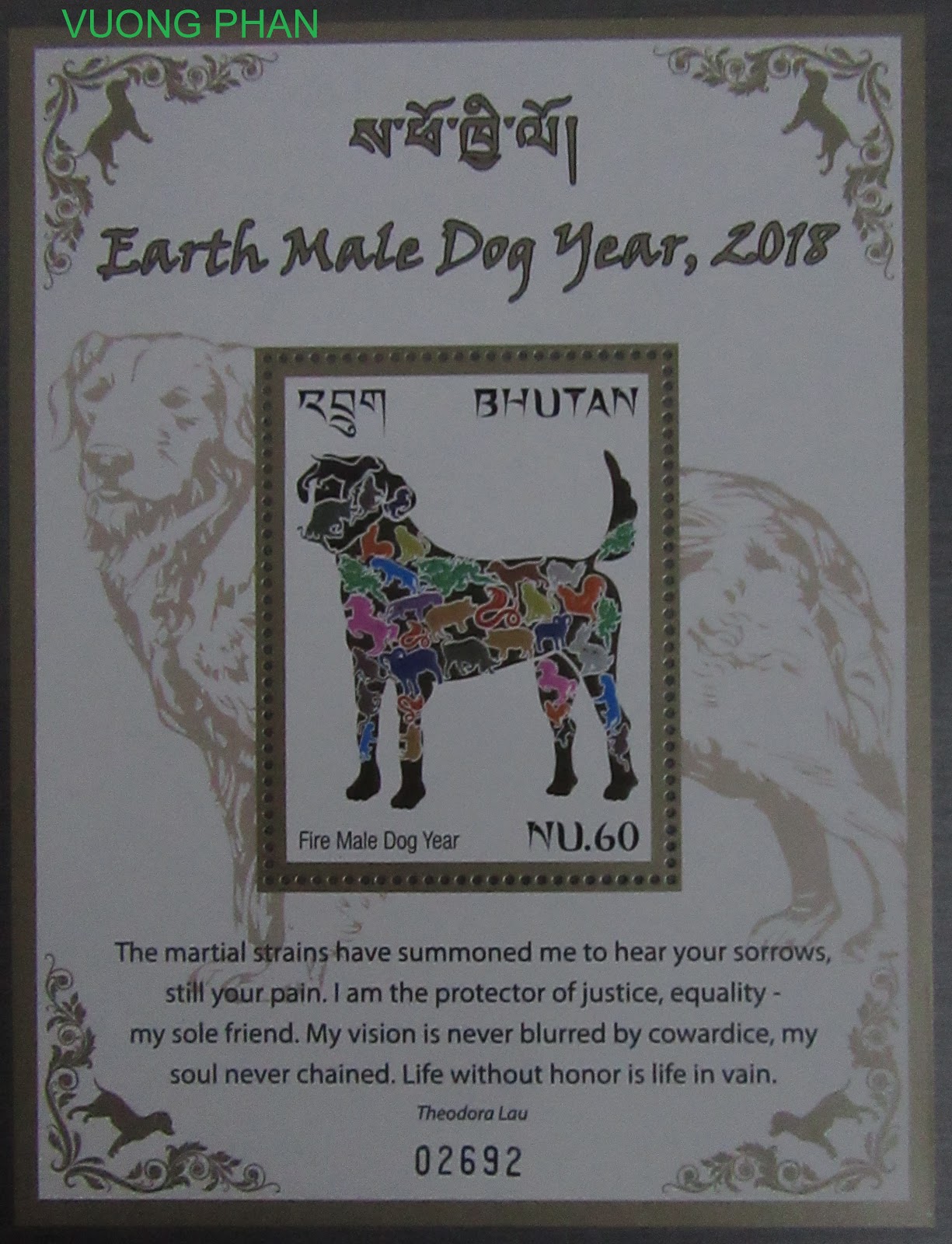
This mail arrived today with an abundance of amazing stamps. I rarely get Bhoutan stamps as there are not any postcrossers in that tiny country to swap. Their stamps are personally quite interesting. The story makes the design, the color of a Buddhism country. All of that facinates me. Receiveing something relating to Buddha, it should be a lucky sign to me. 


Bhoutan post once released a minisheet to celebrate the lunar new year: Year of the rabbit with the same story about Bird, Hare, Monkey & Elephant. The second time this story was used is for year of the Monkey 2016.

The story as follows:

The Four Harmonious Friends (Bird, Hare, Monkey & Elephant)

Wind Fortune
Wind Fortune
FollowWind Fortune

Inbound tour operator at Wind Of Fortune Tours & Travel, Bhutan
Once, the Buddha was travelling, when many younger monks moved ahead to seek shelter. By dusk, a room was prepared for him, as they settled in other rooms. As there was no space allocated for the senior monks Shariputra and Moggallana, they had to sleep outdoors under trees. The next day, the Buddha gathered all to ask which monks deserve the best lodging. Replies included those from – a high caste, the richest, the most learned, the most practiced in meditation and those who reached the destination first. The Buddha replied that seniors should be given the priority, that even animals can show respect to their seniors, which leads to harmonious living and more fortunate rebirths.

The Buddha next shared the story of a bird, monkey and elephant, who lived by a large tree. When there was loss of respect for one another, conflict began. Knowing this is not good, they decided to give priority to the elder ones, by measuring their age with the tree. The elephant remembered it to be as big as a bush when he was a baby. The monkey remembered that its leaves touched his nose then. As the bird said there was a great tree nearby, whose seeds he ate and pooped where the tree now was, they decided that he was the eldest, followed by the monkey and elephant, whose advice should be listened in that order, due to their respective experience.

The bird advised that they should all do good and avoid evil by observing the five precepts of no killing, stealing, sexual misconduct, lying and taking of intoxicants. Thus living peacefully, they were later reborn as humans. The Buddha remarked that the monks too should live happily together by respecting their elders, revealing that he was the wise bird then, that Shariputra was the monkey and Moggallana the elephant! A famous motif (Thunpa Punshi*) with a ‘pyramid’ of four animals depicting this story (from the Jatakas and Vinayavastu) adds a hare (Ananda) to the story. The four discussed about ownership of the tree and agreed to tend to it together. Supporting one another physically, with one above another, they would harvest its fruits.

While the bird planted the seed earlier, the hare watered it, the monkey fertilised it, and the elephant protected it – till it grew into a big beautiful tree full of fruits. Synergising their individual talents, they could reach farther for more literally fruitful results. A version says that when the plant was just a sprout, the bird could scratch around it to find bits to eat. As he was unable to fly, it became difficult to get enough to eat as it grew taller. The hare would eat what was on the ground and lift the bird on his back to reach higher. This was followed by the monkey and the elephant for reaching higher heights, as they collaborated and shared without selfishness.

These ‘four harmonious brothers’ became literally towering good examples in the forest. The bird initiated those with wings to be good, the elephant those with fangs, the hare those with paws, and the monkey those with fur. They even influenced the human kingdom to be moral, which led to higher rebirths. Though simple, this remarkable story bears great truths… on the importance of interdependent cooperation despite differences in size, strength and even species (or race and human-imposed ‘caste’). It also speaks of unity, integrity, friendship, generosity, and selflessness for the greater good. Underlying too are the themes of respecting the spiritual potential of animals, and the protection instead of exploitation of nature.

Ideally, those senior in age are also wiser, and thus worthier of respect. However, as some are ‘older but no wiser’, seniors must be respectful of juniors too. Respect has to earned on both sides. Spiritually, true seniority is by one’s advancement in virtue or practice of the Dharma; not by advancement in years. Again, while it is generally true that the older one is, the better practised one should be, there are the young who are spiritually advanced too – which is another reason why respect must be mutual – for a win-win situation, where the young and old humbly learn from each other. This is crucial to remember – lest one mistakes the story to advocate one-way submission to the elderly without question!

* The Thunpa Punshi is often painted to adorn thangkas, door curtains (see picture), tables, vessels and walls of Buddhist temples and homes. It is believed that wherever this picture is displayed, the wholesome deeds of its beholders and the harmony among them will increase, making much auspiciousness available. There will be no discord or separation between family and friends too, as the picture is a powerful reminder of how we should stay together to help one another. As we all have varying strengths and weaknesses, we can complement one another to accomplish that which we could never achieve alone. Are you initiated by the four harmonious friends yet? Be a harmonious friend today!


Thank you so much A!

jeudi 22 mars 2018

India, Joint issue with Vietnam ,


This mail I took by myself this morning at delivery post office. It was my friend, the sender who texted me that I should go there to take my mail as they has fail in delivering it. Then I checked the status of the mail on Vietnam tracking page and saw that they had tried to delivery it twice afternoon yesterday but no one at home and they had left an invitation paper to pick mail up at their post . I was surpris because of that status as my mom at home all yesterday and no paper left. So I thought that the postman wanted to save his time and simply he had just backed his office with the lie. I sent a reclaim mail to the post and still waiting for what happens next.


The sender used a lot of stamps from last joint issues between Vietnam and India on the architectural topic: Tour in the pagode Phổ Minh and Sanchi stupa. This souvernir sheet was issued on24th Jan, Vietnam version was released on 25th Jan, one day later.

The tour is located in the Phổ Minh Temple. Phổ Minh Temple (Vietnamese: Chùa Phổ Minh, Chinese: 普明寺) is a Buddhist temple in Tức Mặc village, 5 kilometres north of Nam Định city, Vietnam, the home town of the Trần Dynasty. According to official historical documents, the temple was built in 1262, west of the Trần Dynasty's Trung Quang Palace. But according to steles at the temple, the bell of the temple was made since the Lý Dynasty. The temple was possibly extensively renovated in 1262. Through many renovations, there still exist artistic relics from the Trần Dynasty.

The stupa is Great stupa in Sanchi Stupa. Sanchi Stupa, also written Sanci, is a Buddhist complex, famous for its Great Stupa, on a hilltop at Sanchi Town in Raisen District of the State of Madhya Pradesh, India. It is located in 46 kilometres north-east of Bhopal, capital of Madhya Pradesh. The Great Stupa at Sanchi is one of the oldest stone structures in India and was originally commissioned by the emperor Ashoka in the 3rd century BCE. Its nucleus was a simple hemispherical brick structure built over the relics of the Buddha. It was crowned by the chatra, a parasol-like structure symbolising high rank, which was intended to honour and shelter the relics. The original construction work of this stupa was overseen by Ashoka, whose wife Devi was the daughter of a merchant of nearby Vidisha. Sanchi was also her birthplace as well as the venue of her and Ashoka's wedding. In the 1st century BCE, four elaborately carved toranas (ornamental gateways) and a balustrade encircling the entire structure were added. The Sanchi Stupa built during Mauryan period was made of bricks. The complex flourished until the 11th century.


This orchid minisheet arrived inside the mail too. My last time I swapped with India was about 4 years ago, in 2014. But the stamps was not really facinated my eyes because of the quality of image eventhough the designs were very interesting. The paper and the image resolution were so bad so I had stopped to swap for India stamps for a while.

However, when I got this one. My mind was changed. They has ameliorated the quality of stamps a lot. They look so awesome now and I am happy to add them to my collection. Look how nice they are these orchids.


Another minisheet about ASEAN was issued on 25th Jan to show the cultural link beetween India and ASEAN countries. The second one from the right on the bottom rang (yeallow one) shows a vietnamese fesstival). It is Katé festival.

Kate Festival, or also called Mbang Kate, is organized by the Cham people for 3 days at the beginning of October. This event is held in a large space in the three Champa Towers (Po Nagar, Po Klong Garai and Po Rome). The main purpose of the festivals is to commemorate their heroes like Po Klong Garai and Po Rome, and also deaths in the families. Moreover, the festival is a chance for the local people to relax, to meet and wish one another fortune in the future.  


This is one of the biggest and most important events of the Cham people in Vietnam. Therefore, it is a good opportunity for the visitors to explore the beauty in the Cham culture, from architecture to costumes, instruments and traditional songs that are used to praise their kings in the past. The Kate festival in each tower starts at the same time on the same day, and the day after, villages and families begin to hold their own rites. During the rite, the people call their ancestors and gods with the help of a shaman, and then pray for health and prosperity. The actual festivals  take place after the rites. It is a combination of traditional music and dance, including some activities like performances of Ginang Drum and Saranai Flute or the traditional dance of Cham girls.


He gave me some "lucky money" too. I do not collect banknote but some of my swapper sent me some as a gift. They are really nice. Maybe I should begin my new collection.


Thank you so much Aditya!

mercredi 14 juin 2017

India, UNESCO site: Rock Shelters of Bhimbetka;


Thank you Sita!

Rock Shelters of Bhimbetka

UNESCO site
Date of Insscription: 2003

The Rock Shelters of Bhimbetka are in the foothills of the Vindhyan Mountains on the southern edge of the central Indian plateau. Within massive sandstone outcrops, above comparatively dense forest, are five clusters of natural rock shelters, displaying paintings that appear to date from the Mesolithic Period right through to the historical period. The cultural traditions of the inhabitants of the twenty-one villages adjacent to the site bear a strong resemblance to those represented in the rock paintings.

Source: unesco.org

mardi 28 février 2017

India, UNESCO site: Elephanta Caves;


Sent: 11 Feb2017
Arrived: 28 Feb 2017

Thank you so much kraghavendrabhat!

Elephanta Caves

UNESCO site
Date of Inscription: 1987

The Elephanta Caves are located in Western India on Elephanta Island (otherwise known as the Island of Gharapuri), which features two hillocks separated by a narrow valley. The small island is dotted with numerous ancient archaeological remains that are the sole testimonies to its rich cultural past. These archaeological remains reveal evidence of occupation from as early as the 2nd century BC. The rock-cut Elephanta Caves were constructed about the mid-5th to 6th centuries AD. The most important among the caves is the great Cave 1, which measures 39 metres from the front entrance to the back. In plan, this cave in the western hill closely resembles Dumar Lena cave at Ellora, in India. The main body of the cave, excluding the porticos on the three open sides and the back aisle, is 27 metres square and is supported by rows of six columns each.

The 7-metre-high masterpiece “Sadashiva” dominates the entrance to Cave 1. The sculpture represents three aspects of Shiva: the Creator, the Preserver, and the Destroyer, identified, respectively, with Aghora or Bhairava (left half), Taptapurusha or Mahadeva (central full face), and Vamadeva or Uma (right half). Representations of Nataraja, Yogishvara, Andhakasuravadha, Ardhanarishwara, Kalyanasundaramurti, Gangadharamurti, and Ravanaanugrahamurti are also noteworthy for their forms, dimensions, themes, representations, content, alignment and execution.
The layout of the caves, including the pillar components, the placement and division of the caves into different parts, and the provision of a sanctum or Garbhagriha of sarvatobhadra plan, are important developments in rock-cut architecture. The Elephanta Caves emerged from a long artistic tradition, but demonstrate refreshing innovation. The combination of aesthetic beauty and sculptural art, replete with respondent Rasas, reached an apogee at the Elephanta Caves. Hindu spiritualistic beliefs and symbology are finely utilized in the overall planning of the caves.

Criteria (i): The fifteen large reliefs surrounding the lingam chapel in the main Elephanta Cave not only constitute one of the greatest examples of Indian art but also one of the most important collections for the cult of Shiva. 

Criteria (iii): The caves are the most magnificent achievement in the history of rock-architecture in western India. The Trimurti and other colossal sculptures with their aesthetic setting are examples of unique artistic creation.

Source: UNESCO.org